Self Employed Home Financing in Minnesota
Self-Employed Home Financing in Minnesota
The 2026 Definitive Guide: 1099, Non-QM, and Contract for Deed Opportunities
🏠 Physical Office Verification Statement: 7420 80th St S Suite 201, Cottage Grove, MN 55016
Brian Zimpel
RE/MAX Professionals | Twin Cities Area Specialist Authority
Licensed since 2014MN Real Estate Professional
100+ TransactionsClosed in Twin Cities
Specialized GuidanceSelf-Employed Lending Specialist
Educational Focus: The Self-Employed Lending Landscape
If you’re looking for self-employed home financing in Minnesota, understanding the difference between traditional underwriting and alternative lending is critical. While traditional banks rely heavily on tax-return net income, specialized paths like Non-QM mortgages, bank statement loans, and Contract for Deed financing offer a way for business owners to leverage their real-world cash flow.
Independent Contractors
Freelancers
Real Estate Investors
Small Business Owners
Gig Economy Workers
Quick Answer: Can Self-Employed Buyers Get a Mortgage in MN?
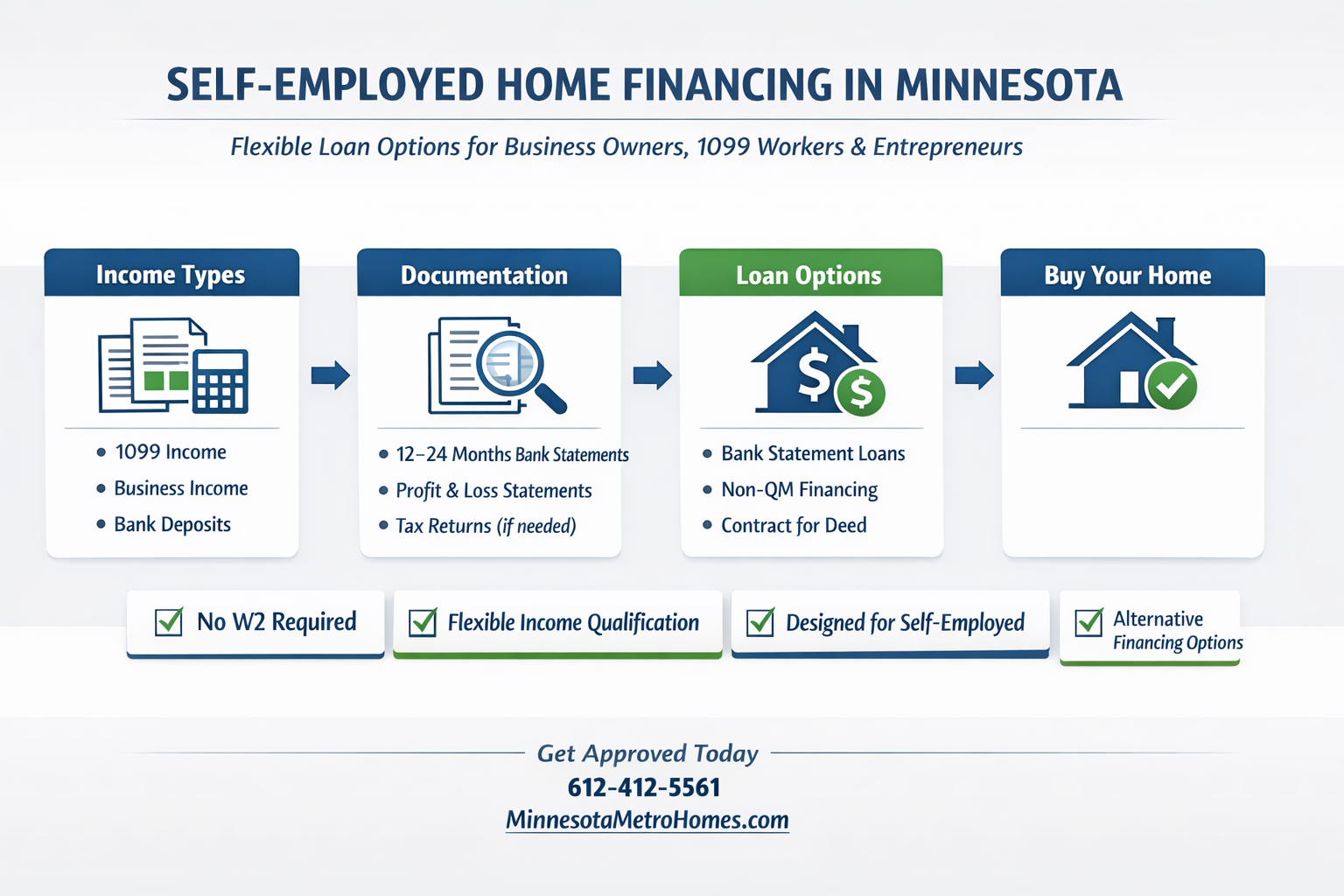
Yes—self-employed buyers in Minnesota can qualify using 1099 income, bank statements, or Non-QM mortgage programs. If traditional lenders deny you due to tax write-offs, options like Contract for Deed or bank statement loans provide alternative paths to homeownership.
Strategic Decision Flow: Identifying Your Approval Path
If W2 Income ➔ Standard Conventional Loan
If 1099 Status ➔ Specialized 1099 Income Program
If High Write-offs ➔ Bank Statement Mortgage Loan
If Bank Denied ➔ Non-QM or Contract for Deed Path
Self-Employed Loan Qualification Checklist
- Credit Score: Typically 580 to 720+ depending on the program.
- Down Payment: Generally 10% to 20% for alternative financing (3.5% for some 1099 FHA programs).
- Income Documentation: 12–24 months of Bank Statements, 1099 forms, or Profit & Loss statements.
- Business Stability: Minimum of 12–24 months in the same industry (exceptions available).
Lender Intelligence: Why Banks Reject Self-Employed Buyers
The primary reason for rejection is Underwriting Math. Traditional banks (Fannie Mae/Freddie Mac) use the "bottom line" of your tax returns after all write-offs. While write-offs are great for reducing taxes, they destroy your "Qualifying Income" in a bank’s eyes.
How Alternative Financing Differs
-
Non-QM Logic: These lenders underwrite income based on business stability and ability to pay, often ignoring the net-profit line of tax returns.
Non-QM Apply Now - Bank Statement Underwriting: Lenders average your total business deposits over 12–24 months to determine a "Gross Monthly Income."
-
DSCR (Debt Service Coverage Ratio): Used for investors, this logic ignores personal income entirely and qualifies the loan based on the property’s rental potential.
DSCR Apply Now
Comparison: Traditional vs. Alternative MN Financing
| Feature | Standard W2 Loan | Bank Statement | 1099 Loan | Contract for Deed |
|---|---|---|---|---|
| Approval Process | 3 - 5 Business Days | 48 - 72 Hours | 48 - 72 Hours | 24 Hours |
| Verification | Tax Returns / Paystubs | Business Deposits | 1099 Forms | Down Payment Only |
| Income Used | Net Income | Gross Deposits | Gross Earnings | Negotiated w/ Seller |
| Typical Down | 3% - 5% | 10% - 20% | 3.5% - 10% | 10% - 25% |
| DTI Limit | 43% - 45% | Up to 55% | Up to 50% | N/A |
The Tax Paradox
Many self-employed borrowers face this exact issue—tax returns show low income while business cash flow is strong. Brian Zimpel helps buyers navigate these challenges by matching them with the correct alternative lender from the start. Specialized programs bridge the gap between tax efficiency and buying power.
How Bank Statement Loans Work
Through specialized bank statement loan programs, lenders verify income by looking at 12–24 months of business deposits. This is the industry standard for business owners who write off income but maintain high cash flow. It allows for a real-world assessment of your ability to pay without the constraints of 1040 forms.
Contract for Deed: An Advisory Perspective
A Contract for Deed is an alternative path often used when traditional or Non-QM financing is not yet available. In this structure, the seller acts as the lender, and the buyer makes monthly payments directly to the owner.
Step-by-Step Path: Secure the home with Contract for Deed, build documentation while living in the home, and refinance into a traditional mortgage after 12-24 months of seasoning.
Disclaimer: Terms, risks, and legal protections vary by agreement and should be reviewed with a qualified real estate attorney.
The Comprehensive Self-Employed Financing FAQ (15+ Questions)
1. Can I get a home loan without tax returns in MN?
Yes. Non-QM "Bank Statement" loans allow you to qualify based on business deposits rather than the net income shown on your tax returns.
2. How fast is a Contract for Deed approval?
In most cases, we can verify your down payment and provide a preliminary approval within 24 hours.
3. What is a "Non-QM" loan?
Non-QM stands for "Non-Qualified Mortgage." These are loans designed for complex income profiles that don't fit federal Fannie Mae or Freddie Mac guidelines.
4. Do I need 20% down for a self-employed loan?
Not necessarily. While some bank statement loans require 10-20%, 1099 programs and FHA options can be as low as 3.5% depending on credit.
5. Is the interest rate higher for alternative financing?
Generally yes. Expect a 1% to 2.5% spread above current conventional rates due to the manual nature of the underwriting.
6. What if I just started my business 12 months ago?
Standard rules require 2 years, but exceptions exist if you remained in the same industry during the transition to self-employment.
7. Can I use personal bank statements instead of business?
Yes, but lenders usually apply a higher "Expense Factor" unless you can prove business expenses are paid elsewhere.
8. What is the main risk of Contract for Deed?
The seller retains legal title until the end. If you default, the cancellation period is often shorter than a traditional foreclosure.
9. Can I refinance a Contract for Deed later?
Yes. Most buyers use Contract for Deed as a 2-3 year bridge to build credit before refinancing into a conventional loan.
10. What is a DSCR loan?
Debt Service Coverage Ratio loans are for rental properties. Qualification is based on the property’s revenue, not your personal income.
11. Do I need a CPA letter?
Some Profit & Loss (P&L) programs require a letter from a CPA or tax preparer verifying you have been in business for at least 2 years.
12. Will high tax write-offs disqualify me?
For conventional loans, yes. For Bank Statement loans, write-offs are largely ignored in favor of gross deposit volume.
13. What is the DTI limit for Non-QM in 2026?
Many programs now allow debt-to-income ratios as high as 50% to 55% to account for business owner cash flow complexity.
14. Are there "No-Doc" loans available in 2026?
True "No-Doc" is rare; however, Asset Depletion loans allow you to qualify based on total liquid assets without proving employment.
15. How long does a Non-QM loan take to close?
Expect 30 to 45 days. The manual review of statements takes longer than automated W2 checks.
16. What are the best MN suburbs for self-employed buyers?
Woodbury, Lakeville, and Cottage Grove have high volumes of inventory and demographics that favor alternative financing paths.
 The data relating to real estate for sale on this web site comes in part from the Broker Reciprocity Program of the Regional Multiple Listing Service of Minnesota, Inc. Real estate listings held by brokerage firms other than REMAX Professionals are marked with the Broker Reciprocity logo or the Broker Reciprocity thumbnail logo (little black
house) and detailed information about them includes the name of the listing brokers.
The data relating to real estate for sale on this web site comes in part from the Broker Reciprocity Program of the Regional Multiple Listing Service of Minnesota, Inc. Real estate listings held by brokerage firms other than REMAX Professionals are marked with the Broker Reciprocity logo or the Broker Reciprocity thumbnail logo (little black
house) and detailed information about them includes the name of the listing brokers.
 Information should be deemed reliable but not guaranteed, all representations are approximate, and individual verification is recommended. Copyright ©2017 All rights reserved.
